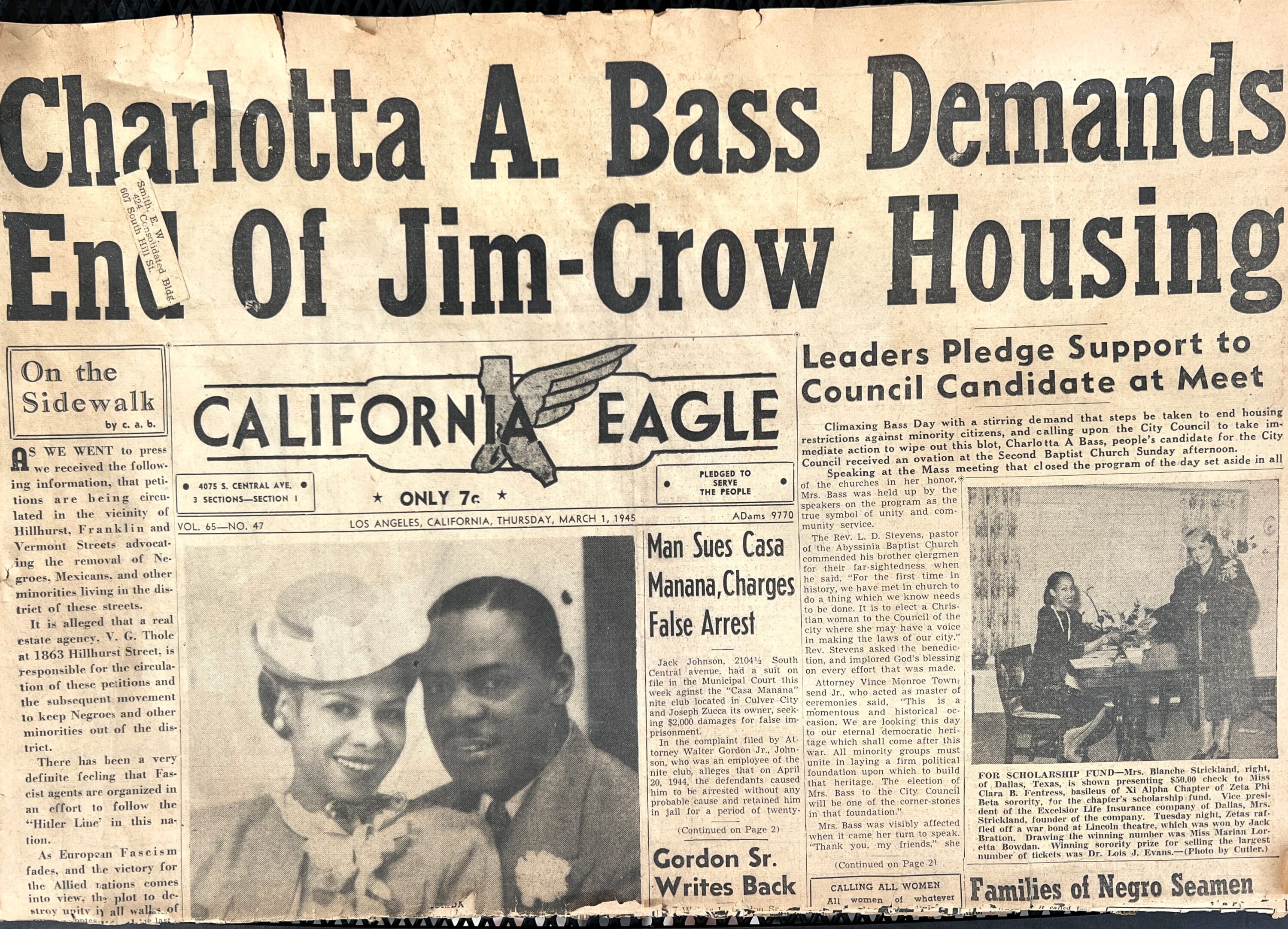
Charlotta Bass’s husband would sometimes warn her that she was going to get him killed. She would remind him it would be for a good cause. In her memoir she mentions a night when eight members of the Ku Klux Klan attempted to enter the locked door of her office at the California Eagle, then retreated when she reached into her desk for a gun she did not know how to use. When federal officials sought to revoke her passport, she reportedly refused to surrender it.
These accounts suggest both the risks attached to the stories Bass insisted on telling and the fierceness required to keep telling them. She carried out her work as editor and publisher of the California Eagle, one of the oldest Black newspapers on the West Coast. Long before her 1952 campaign for vice president, Bass was building narratives that challenged what people were and were not willing to hear. “I will not retire nor will I retreat, not one inch, so long as God gives me vision to see what is happening and strength to fight for the things I know are right,” she said in her nomination acceptance speech.
Bass used her journalism to document lynchings, school segregation, discriminatory housing practices, and economic exploitation of Black workers. She mentored Black women and insisted that their voices belonged in journalism and politics. Over decades, she repeatedly connected the issue of racial equality to the larger struggles for peace, labor rights, women’s rights, and economic justice.
Bass was not simply reporting events. She was challenging the frame through which the country understood them.
During World War II, federal authorities monitored many Black newspapers, including the California Eagle, ostensibly for signs of sedition. These newspapers reported on conditions that broader public discourse avoided, including the contradiction of asking Black Americans to fight fascism abroad while denying them full citizenship at home.
As anti-communism intensified after the war, Bass’s decades of activism, politics, and international travel increasingly drew federal attention that recast her demands for justice as threats. With nearly four decades of journalism and organizing behind her, Bass carried that record of public advocacy and scrutiny into the 1952 presidential campaign. In March of that year in Chicago, she stood before the Progressive Party’s national convention and became the first Black woman nominated for vice president by a national political party, and the first to appear on the general election ballot for that office. Her campaign slogan was, “Win or lose, we win by raising the issues.”
I came to Charlotta Bass’s story not in a U.S. history class as one might expect, but through marriage to one of her descendants. When I finally learned her story, I was grateful to know it and astounded that I had never heard about her before.
Recently I re-read her nomination acceptance speech which, like her life’s work, framed issues in broad, structural terms. She connected social and political challenges that many mainstream accounts treated separately. She pointed out, for example, that peace needed to include Black freedom, that war spending should not be considered apart from poverty at home, and that women’s rights would require political power. And she spoke not as someone merely grateful to stand on that stage, but as someone who had spent decades making the stage larger. In effect, she asked where the great leaders of the nation had been when Black Americans were being lynched, kept out of employment and housing, and denied the basic protections of citizenship.
As I reread the speech, something occurred to me that I had somehow not yet connected. According to genealogical records, Dwight Eisenhower appears to be my sixth cousin twice removed, a familial tie so faint it means very little in practical terms. Still, for me that small personal link provided a flash of recognition. This was the man she ran against, a figure associated with a very different national story.
Until then, I had thought of these two figures separately. Charlotta’s story reached me because I married into her family. My connection to President Eisenhower came through a Pennsylvania Dutch lineage I had traced. I had never placed them within the same personal frame: that one family line led back toward one of the most familiar public narratives in American political life, while another revealed the woman who challenged that narrative from outside of its frame.
By the time of the 1952 campaign, a familiar version of Eisenhower was already established. He had served as the Supreme Allied Commander who had led the country to victory in Europe. He was the leader who would restore order. Bass was offering another account of the same moment, one that expanded the national order to include the freedoms and protections still denied to Black Americans.
The facts of Bass’s life were always there, somewhere. I simply had not encountered them. She had spoken boldly on a national platform in her own time, yet decades later her story is something most of us have to stumble upon. Her absence from the history I was taught is not a measure of the importance of her work, but of the limits of what public narratives preserved and made memorable.
Her story may have receded from public memory for many of us, but the patterns she faced have not disappeared. Those who raise difficult issues can still be portrayed as more threatening than the issues themselves. Attention is diverted from what has been raised toward the person willing to raise it, leaving the underlying reality unchanged and the messenger more vulnerable than before.
When I first read Bass’s slogan, “Win or lose, we win by raising the issues,” I misinterpreted it as almost mundane. Seen in the context of public narrative, the message becomes both plainspoken and powerful: raising the issues, now as then, can widen the territory, making visible what our most familiar stories often do not contain.
Sources and further reading:
Primary sources: Charlotta Bass’s memoir, Forty Years: Memoirs from the Pages of a Newspaper; Bass’s March 30, 1952 acceptance speech as the Progressive Party’s vice-presidential nominee in Chicago; and an original hardcopy issue of the California Eagle reviewed by the author.
Biographical and historical background: Biographical materials from the National Park Service and PBS’s The Black Press: Soldiers Without Swords.
Federal monitoring and Black press context: Patrick S. Washburn’s A Question of Sedition: The Federal Government’s Investigation of the Black Press During World War II and publicly available materials related to Bass’s FBI file.
Campaign, quotations, and genealogy: The quotation “I will not retire nor will I retreat, not one inch…” is from Bass’s 1952 Progressive Party acceptance speech. The slogan “Win or lose, we win by raising the issues” is widely associated with Bass’s 1952 vice-presidential campaign. Genealogical references to Dwight Eisenhower are based on the author’s review of records available through MyHeritage.com; they are included as part of the essay’s personal narrative frame and are not intended as a central historical claim.